

The Giant in Cell Biology: CHO Series
Part 1
Past and Present
The mammalian CHO cell line is the most widely used host for the expression and production of biological products. It is applied to manufacture drugs including interferons, interleukins, EPO, monoclonal antibodies, diagnostic reagents, and recombinant protein vaccines.
Today, the market value of drugs expressed using CHO cells amounts to hundreds of billions of US dollars. As a giant in the cell world, its emergence has injected endless vitality into the global biopharmaceutical industry and generated enormous scientific and economic value.
No one succeeds easily, and behind the discovery and development of CHO cells lies a remarkable history. Today, let us briefly review the past and present of CHO cells.
Past and Present of CHO Cells
Let us turn back time to 1919, during the outbreak of the Spanish flu, when many patients developed pneumonia. Unlike today’s advanced diagnostic technologies, doctors had to culture bacteria from patients’ lungs to identify pneumonia types, and rodents were used as “test reagents”.
A hundred years ago, however, laboratory mice were not widely available; they were rare and expensive. Dr. E. T. Hsieh from Peking Union Medical College searched extensively in Beijing for an alternative to mice and unexpectedly discovered the Chinese hamster (Cricetulus griseus). This rodent, native to northern China and Mongolia, was abundant. He obtained some for experiments and achieved great success. From then on, the wheel of fate for Chinese hamsters began to turn…

In 1928, also at Peking Union Medical College, a researcher named Marshall Hertig brought 150 Chinese hamsters to Harvard Medical School, hoping to establish a stable strain, but unfortunately failed.
Fast forward to 1943. Guido Pontecorvo, a pioneer of modern genetics, observed Chinese hamster chromosomes under a low‑power microscope and reported only 14 (the actual number is 2n=22), far fewer than other common laboratory rodents (40 in mice, 42 in rats). This made Chinese hamsters valuable for chromosome research.
Gradually, more researchers recognized the value of Chinese hamsters and sought to breed them on a large scale. One of them was Victor Schwentker, an American who owned the largest laboratory animal farm in the northeastern US. He commissioned Dr. Robert Briggs Watson, who was studying malaria in China, to help acquire them.
In the winter of 1948, at the risk of his life, Dr. Robert Briggs Watson transported 20 Chinese hamsters gifted by Professor Hu Zhengxiang through war‑torn regions to San Francisco, USA, and finally delivered them safely to Victor Schwentker in New York.

After surviving great hardships, Chinese hamsters were successfully domesticated into a laboratory strain by Victor Schwentker over two years. Many researchers came to obtain them. A side note: using a better microscope, George Yerganian of Harvard University discovered that Chinese hamsters have 22 chromosomes, not the 14 reported earlier by Pontecorvo. Even so, Chinese hamsters remained ideal for chromosome studies.
In 1957, Dr. Theodore T. Puck and his colleague Fa-Ten Kao at the University of Colorado Medical Center obtained a female Chinese hamster from the laboratory of Dr. George Yerganian at the Boston Cancer Research Center and cultured cells from its lung, kidney, spleen, and ovary in vitro.
Unlike cancer cells that can proliferate indefinitely, normal somatic cells stop dividing and die after a limited number of cycles, especially in an artificial environment like a culture dish. However, the ovarian cells from this Chinese hamster were exceptional: they could proliferate infinitely like cancer cells and fully adapted to in vitro culture.
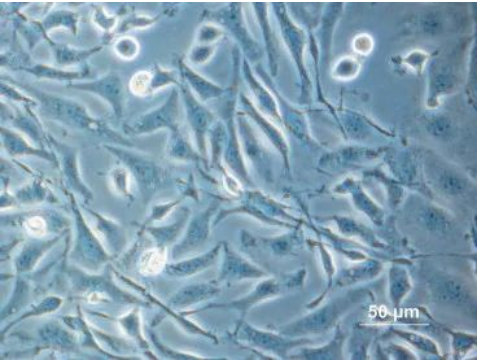
CHO Cell Line
This ability for unlimited proliferation is called “immortalization”. The well‑known HeLa cells are immortal human cells in vitro. CHO cells were the first animal cells to achieve spontaneous immortalization in culture.
Thus, Puck successfully isolated the CHO cell line. It quickly became the standard cell line in the biopharmaceutical industry. Just as E. coli is the standard model for microbiology, Puck called CHO cells the “E. coli of mammalian cells”.
In 1984, Genentech first expressed recombinant tissue plasminogen activator (t‑PA) in CHO cells, which was approved and launched in 1987. This marked a milestone in protein drug production using mammalian cell expression systems.
Subsequently, many foreign protein genes were transfected into mammalian cells, and numerous valuable proteins were expressed, including clotting factors, erythropoietin (EPO), immunoglobulins, urokinase, hepatitis B surface antigen (HBsAg), and monoclonal antibodies, greatly advancing the biopharmaceutical industry.
Meanwhile, with the widespread use of CHO cells in laboratories, scientists isolated various subtypes such as CHO‑S, CHO DXB11, CHO DG44, CHO‑M, and more recently GS‑knockout CHO cell lines (e.g., Merck/Sigma‑Aldrich CHOZN, Lonza CHO GS Xceed, Horizon rAAV‑mediated GS‑KO CHO).
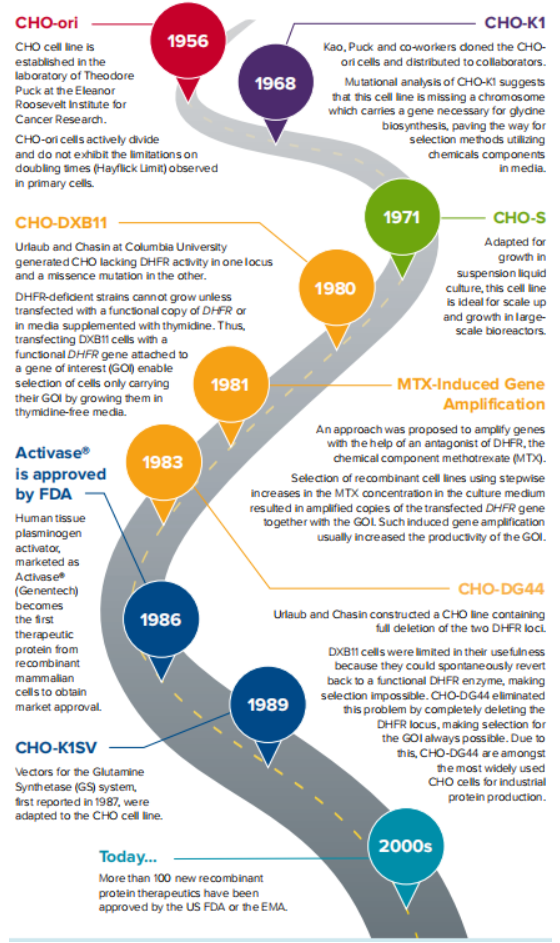
Absolute Advantages of CHO Cells
CHO cells are highly valued in biopharmaceuticals for the following reasons:
1. Clear genetic background and high safety. Proteins expressed in CHO cells are readily approved by regulatory agencies.
2. Ability to express complex recombinant proteins. Over 70% of animal cell‑derived therapeutic proteins are produced in CHO cells. Among 27 monoclonal antibodies approved by June 2011, 13 (about 50%) were expressed in CHO cells. Of approximately 30 approved genetic engineering products for human disease, only one (hepatitis B vaccine) uses yeast; all others use CHO or E. coli. Unlike E. coli, CHO cells enable active dimer formation and glycosylation (e.g., EPO), making them ideal for complex biomacromolecules.
3. As non‑secretory fibroblasts, CHO cells secrete very little endogenous protein, greatly simplifying target protein purification. Various CHO variants have been developed via drug pressure, extreme screening, and mutagenesis.
4. Accurate post‑translational modification. Glycosylated proteins expressed in CHO closely resemble human proteins in structure, properties, and function, including glycosylation and sialylation.
5. High‑efficiency amplification and expression of foreign recombinant genes. Multiple commercial systems are available: DHFR, glutamine synthetase (GS), and geneticin selection systems.
6. Adaptable to both adherent and suspension culture, with high tolerance to shear stress and osmotic pressure. They grow rapidly to high density in serum‑free media, greatly facilitating quality control and large‑scale production.
CHO Residual DNA Detection
Host cells such as CHO, E. coli, and Vero are widely used in biomanufacturing. Released DNA carries potential risks of tumorigenicity, mutagenicity, and immunogenicity. Therefore, strict limits on residual host cell DNA are set by the WHO, FDA, EMA, and NMPA.
Rocgene has developed a comprehensive residual DNA detection portfolio covering CHO, E.coli, Vero, NS0, Sf9&AcMNPV, HEK293, Plasmid, SV40&E1A residual DNA quantification kits. These kits are compatible with Rocgene’s Archimed X series qPCR instruments as well as 7500, StepOne Plus, CFX96, and other major qPCR systems.
Supporting products include host cell residual DNA extraction kits and automated nucleic acid extraction instruments. Rocgene’s biomanufacturing residual testing solution covers sample pretreatment, qPCR instruments, and detection kits, enabling simple and reliable residual testing.
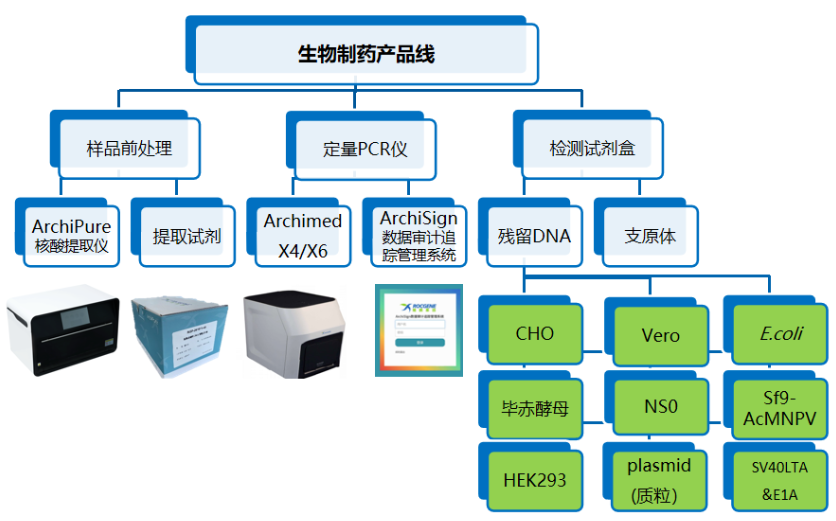
Product Features
1. Accurate: Calibrated to national standards; CV<5%.
2. Sensitive: Stable detection at fg‑level host DNA.
3. Fast: Complete assay in 60 minutes.
4. Anti‑contamination: dUTP+UNG system prevents aerosol contamination.
5. Convenient: Ready‑to‑use master mix; no reaction setup required.
6. Cost‑effective: Equivalent or superior performance at a better price.
References
Rawley JD. Theodore T. Puck (September 24, 1916–November 6, 2005). American Journal of Human Genetics 2006;78(3):365–366.
Kim JY et al. CHO cells in biotechnology for production of recombinant proteins: current state and further potential. Applied Microbiology and Biotechnology 2012;93(3):917–930.
Urlaub G, Chasin LA. Isolation of Chinese hamster cell mutants deficient in dihydrofolate reductase activity. Proc Natl Acad Sci USA 1980;77(7):4216‑4220.
Landauer K, Woischnigg H, Hepp N et al (2011) Development of a chemically defined CHO medium by engineering based on a feed solution. BMC Proc 5(Suppl 8):P41.
CHO MEDIA PLATFORM FACILITATES INTEGRATED CELL LINE DEVELOPMENT AND MEDIA OPTIMIZATION, Irvine Scientific Poster in ESACT 2017.
06
16
08
18


 +86-010-86229225
 info@rocgene.com
 CN
CN